Understanding the Benefits of Shea Butter in Soap
Shea butter in soap does more than moisturise. It protects, soothes, and nourishes. Here is what makes it one of the most effective ingredients in natural skincare, and why it belongs in your daily wash.
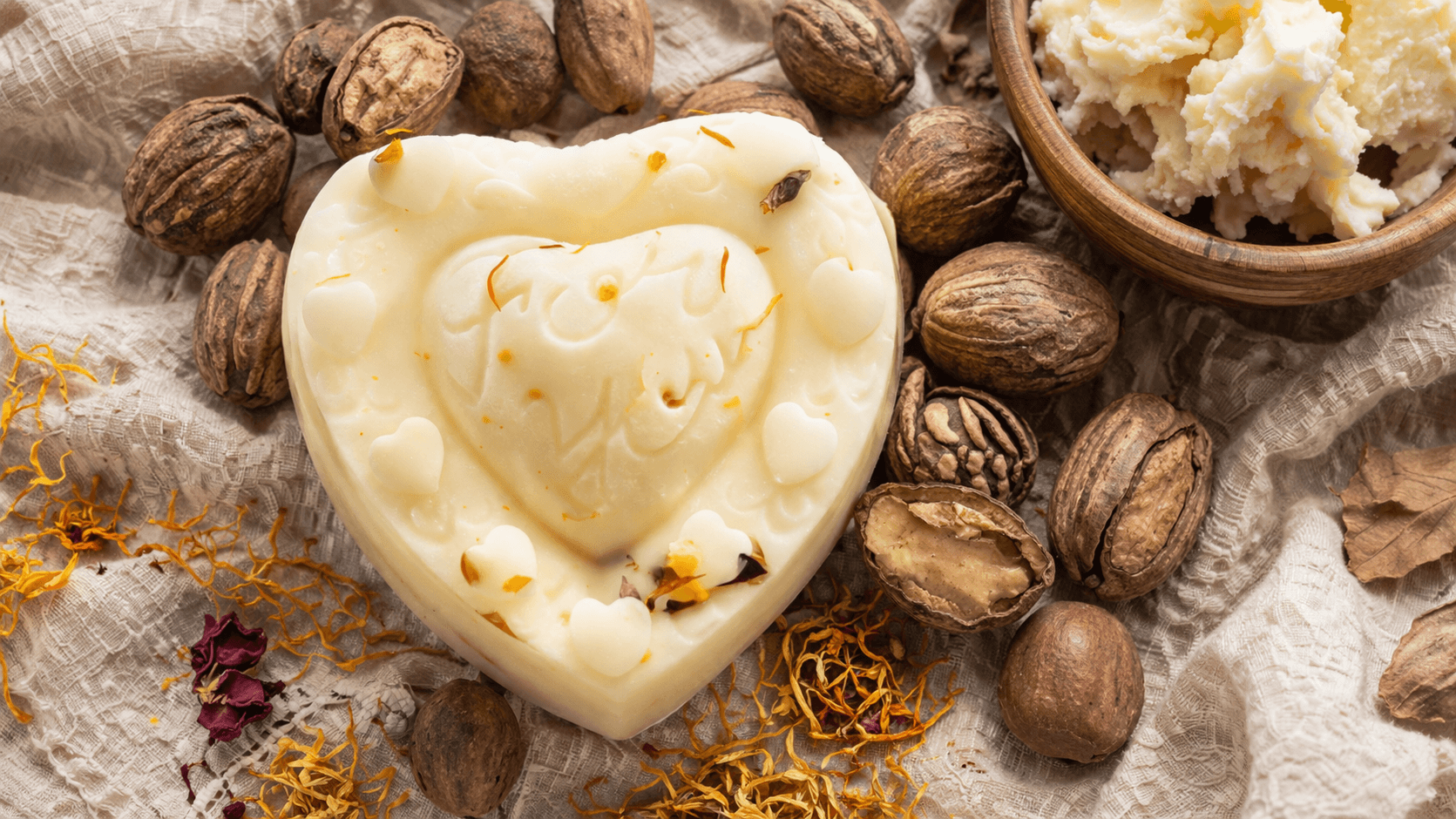
Most soaps clean your skin by removing things: oil, dirt, dead cells. That part is fine. The problem is they often remove things your skin needs to keep: its natural oils, its moisture, the protective layer it maintains with some effort every day. After washing you are left with skin that works to rebuild what was just stripped away.
Shea butter changes that equation. It is one of the few ingredients that cleanses and supports the skin barrier at the same time. Understanding why requires looking at what shea butter actually is and what happens to it during the soap-making process.
What is shea butter?
Shea butter comes from the nut of the shea tree, Vitellaria paradoxa, which grows across the savannah belt of West and Central Africa. The nut is dried, crushed, and pressed to extract the fat. What you get is a dense, ivory-coloured butter that has been used for centuries across West Africa for skin, hair, and wound care, long before it became a common ingredient in commercial skincare.
Raw shea butter contains a complex mix of fatty acids, primarily oleic acid and stearic acid, with smaller amounts of linoleic and palmitic acid. It also contains vitamins A, E, and F, and a group of non-saponifiable compounds, meaning they do not convert into soap during the saponification process. This last point is what makes shea butter particularly valuable in soap.
Refined shea butter has most of these properties stripped out during processing to extend shelf life and produce a neutral scent. Raw shea butter retains them. There is a difference, and it shows on skin.
How shea butter works on skin
It fills the skin barrier rather than coating it
Shea butter is an emollient. Emollients work by filling the microscopic gaps in the skin's surface layer, the spaces between cells where moisture escapes and irritants enter. A film-forming moisturiser sits on top of the skin and acts as a temporary barrier. Shea butter works from within the barrier itself.
The fatty acids in shea butter are structurally similar to the lipids your skin produces naturally. This is why skin absorbs shea butter rather than sitting with it on the surface. After washing with a shea butter soap, you will notice the difference in how skin feels: not heavy, not coated, just genuinely soft.
It slows moisture loss
One of the main problems with dry skin is transepidermal water loss: moisture evaporating from the skin surface faster than the skin can replenish it. Shea butter's stearic and oleic acid content slows this process by reinforcing the outer skin layer. The result is skin that holds its moisture for longer between washes.
This matters especially in dry or cold conditions when moisture loss accelerates and the skin barrier is under additional stress.
It calms inflammation
Raw shea butter contains cinnamic acid esters and lupeol, compounds with documented anti-inflammatory properties. These are among the non-saponifiable components that survive the soap-making process. For skin dealing with redness, irritation, eczema, or psoriasis, this is a meaningful property. The soap cleans without aggravating the condition underneath.
It is worth being clear about what this means in practice. A shea butter soap will not treat a skin condition. But it will not make it worse either, which is more than can be said for most conventional soap.
It does not clog pores
Rich ingredients often come with a concern about breakouts. Shea butter has a low comedogenic rating: it does not tend to block pores despite its richness. This makes it workable for combination skin and for people who want the moisturising benefits without the risk of congestion.
Why shea butter belongs in soap
The obvious place for shea butter is a leave-on product: a cream, a balm, a moisturiser. But there is a strong case for having it in soap instead, or as well.
Most people moisturise inconsistently. They wash every day. If the moisturising ingredient is in the soap, it reaches the skin daily without requiring an extra step. This is not a workaround. It is how well-made handmade soap has always worked.
When shea butter is added to a soap base, it goes in after saponification has already taken place. This means it is not converted into a cleansing molecule. It stays intact in the bar. When you wash, those shea butter compounds (vitamins, cinnamic esters, fatty acids) are deposited on the skin and left there after rinsing.
Commercial soap manufacturers remove the glycerin produced during this process because it is more profitable to sell separately. Handmade soap retains it. Combine retained glycerin with shea butter superfatting and you have a bar that actively nourishes skin while it cleans, not a bar that markets itself as moisturising while doing the opposite.
Benefits for dry and sensitive skin
Shea butter soap is particularly suited to skin types that most soaps make worse.
Dry and very dry skin is the most obvious fit. If your skin feels tight after every wash regardless of what you use, shea butter soap is worth trying before you blame your moisturiser.
Sensitive and reactive skin benefits from both the anti-inflammatory compounds and the absence of synthetic fragrance, sulphates, and preservatives that a properly made shea butter soap will not contain. It is rare to find an ingredient this nourishing that is also this unlikely to cause a reaction.
Mature skin loses lipids with age. The skin barrier becomes thinner and less effective at holding moisture. Shea butter's fatty acid profile compensates directly for this loss, and the vitamin A content supports cell renewal in skin with slower turnover.
Dry patches (elbows, knees, heels, shins) respond well to shea butter used consistently. The bar can be held on a dry patch longer than you would wash normally, letting the superfat absorb while the lather does its work.
Post-shave skin is inflamed by definition. The anti-inflammatory properties of shea butter make it a better choice than most commercial post-shave products, which often contain alcohol alongside their soothing ingredients.
Why choose shea butter soap?
Because it is one of the few cleansing ingredients that leaves your skin in better condition than it found it.
Most soap is a net negative for skin health: you clean, you lose moisture and barrier integrity, you compensate with a separate product. Shea butter soap disrupts that cycle. You still clean. But the moisture stays, the barrier is supported, and for most people the separate moisturiser becomes optional.
If you are comparing options, shea butter against glycerin or goat milk, the distinction is weight and depth. Glycerin is light and clean; goat milk is gentle and nourishing; shea butter is the richest of the three and the most conditioning. The right choice depends on your skin, but if dryness is the central problem, shea butter is usually the right answer.
How to use it
Warm water, not hot. Hot water opens the pores but also strips oil more aggressively, working against what the shea butter is trying to do.
Pat dry. Rubbing removes moisture and disrupts the thin layer of superfat the bar has just deposited.
Use it daily. The benefits of shea butter soap are cumulative. A bar used consistently for two to three weeks produces noticeably different skin than one used occasionally. The skin barrier improves with support, not just with individual applications.
No additional moisturiser is necessary for most people once the skin has settled in. If you want one, apply it within a few minutes of washing while the skin is still slightly damp.
You can find our shea butter soap in the shop, made in small batches at our farm in South Goa with raw shea butter and no synthetic additives.
Written by Healing Soil
"Came out of the shower smelling like a baby"
Try our handmade soaps
Made to order from our farm in Goa. No chemicals. No shortcuts.
Shop the collection